
This concert features music by two prolific composers, both devout Catholics, writing instrumental works that wordlessly depict scenes from the New Testament. Heinrich Ignaz Franz von Biber was a virtuoso violinist but was also known for his composition of an impressive body of sacred works. In 1676 he produced a set of 15 sonatas for violin and continuo that depicted the life of Christ. These works correspond to the practice of Rosary processions that date back to the 13th century. In our concert we present four scenes: The Annunciation, The Nativity, The Crucifixion, and The Ascension. After intermission the concert concludes with Olivier Messiaen‘s Quartet for the End of Time, a work inspired by verses from the Book of Revelation and recognized as one of the greatest masterpieces of the 20th century.
Heinrich Ignaz Franz von Biber was born in Bohemia in 1644 and as a young man worked at the courts of Graz and Kroměříž (now in the Czech Republic). From the 1670’s until the end of his life, he was employed at the archbishop’s court in Salzburg. There he rose to the rank of Kapellmeister and was eventually granted a title of nobility by the emperor.
Biber was perhaps the greatest violinist of the seventeenth century. He wrote a great deal of experimental music for his own instrument but also many choral works of different scopes. His choral output includes masses, requiems, motets, and other vocal compositions. Some works were among the grandest church music of his time.
There is only one surviving manuscript copy of The Mystery Sonatas dating from around 1676, and the pieces were not published until 1905. The original manuscript is beautifully copied and includes all fifteen sonatas with a final Passacaglia for unaccompanied violin. Each sonata is connected to a specific point in the life of Christ and the corresponding rosary meditation. In the manuscript there is also an engraving depicting the scene in the story at the start of each piece.
The Sonatas are grouped in sets of five. These are:
The Joyful Mysteries:
Sonata I in D minor – The Annunciation; Sonata II in A Major – The Visitation; Sonata III in B minor – The Nativity; Sonata IV in D minor – The Presentation of Jesus in the Temple; and Sonata V in A Major – The Finding of Jesus in the Temple
The Sorrowful Mysteries:
Sonata VI in C minor – The Agony in the Garden; Sonata VII in F Major – The Scourging of Jesus; Sonata VIII in Bb Major – The Crowning of Jesus with Thorns; Sonata IX in A minor – The Carrying of the Cross; and Sonata X in G minor – The Crucifixion
The Glorious Mysteries:
Sonata XI in G Major – The Resurrection; Sonata XII in C Major – The Ascension; Sonata XIII in D minor- The Descent of the Holy Ghost; Sonata XIV in D Major – The Assumption of the Virgin; and Sonata XV in C Major – The Coronation of the Virgin Mary
Passacaglia in G minor for violin alone
Biber’s sonatas do not tell the story of the lives of Jesus and Mary in any explicit way. The music instead provides moments of reflection leaving each listener to find his or her own meaning.
The engravings from Biber’s score and the biblical text of the story are all the commentary needed to approach the selection of four sonatas we are including in this concert:
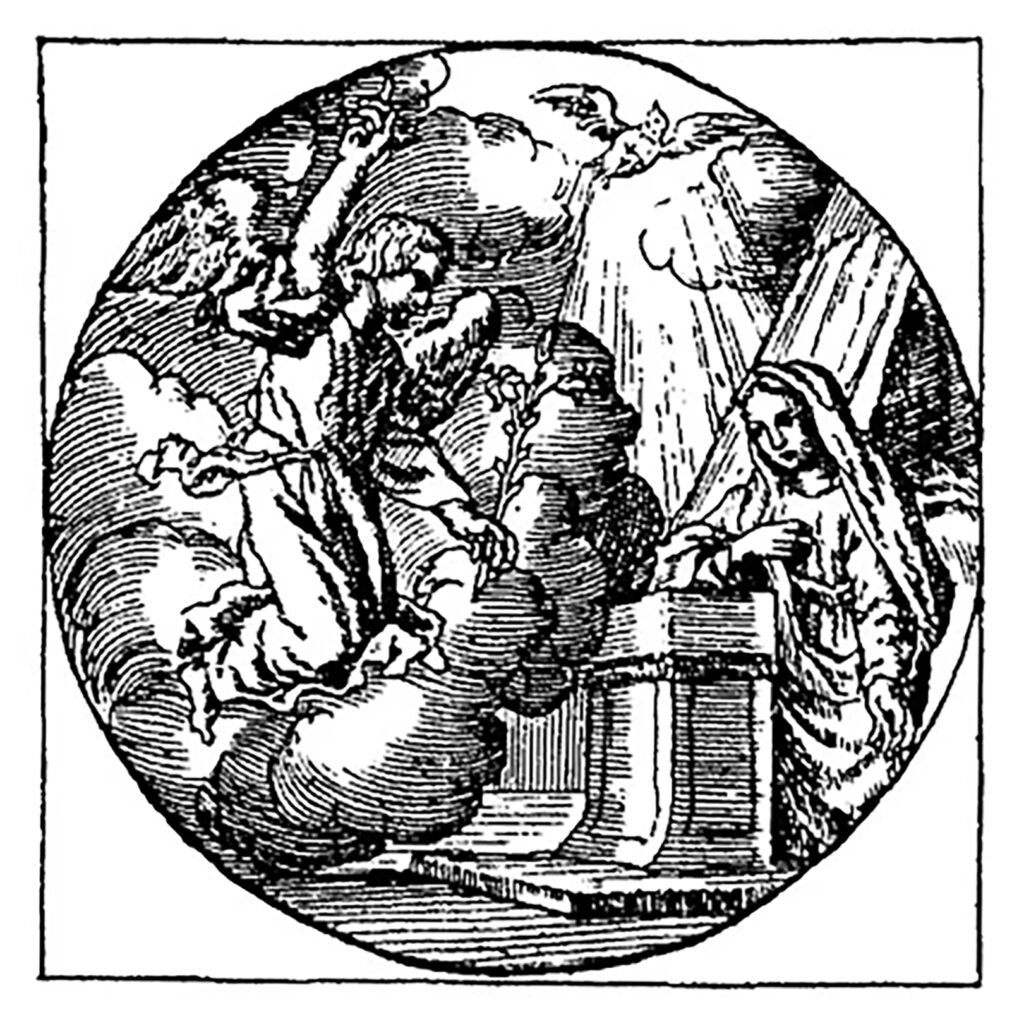
Luke 1:26-28 — The annunciation of the birth of Jesus
26 In the sixth month, Gabriel (the angel) was sent from God to a town in Galilee called Nazareth, 27 to a virgin engaged to a man called Joseph, from the family of David. The virgin was called Mary. 28 “Greetings, favored one!” said the angel when he arrived. “May the Lord be with you!”
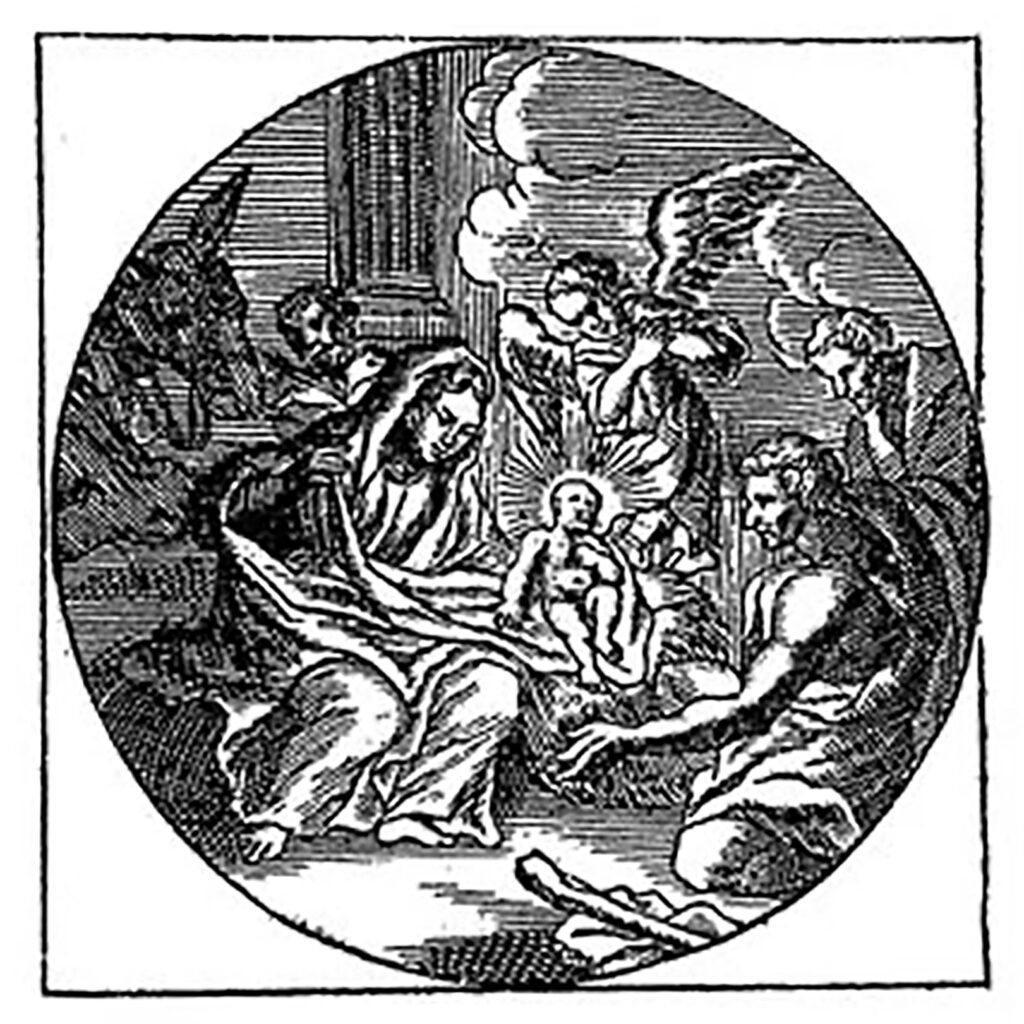
Luke 2:1-21 — The Birth of Jesus
4 So Joseph also went up from the town of Nazareth in Galilee to Judea, to Bethlehem the town of David, because he belonged to the house and line of David. 6 While they were there, the time came for the baby to be born, 7 and she gave birth to her firstborn, a son. She wrapped him in cloths and placed him in a manger, because there was no guest room available for 11 Today in the town of David a Savior has been born to you; he is the Messiah, the Lord. 12 This will be a sign to you: You will find a baby wrapped in cloths and lying in a manger.”
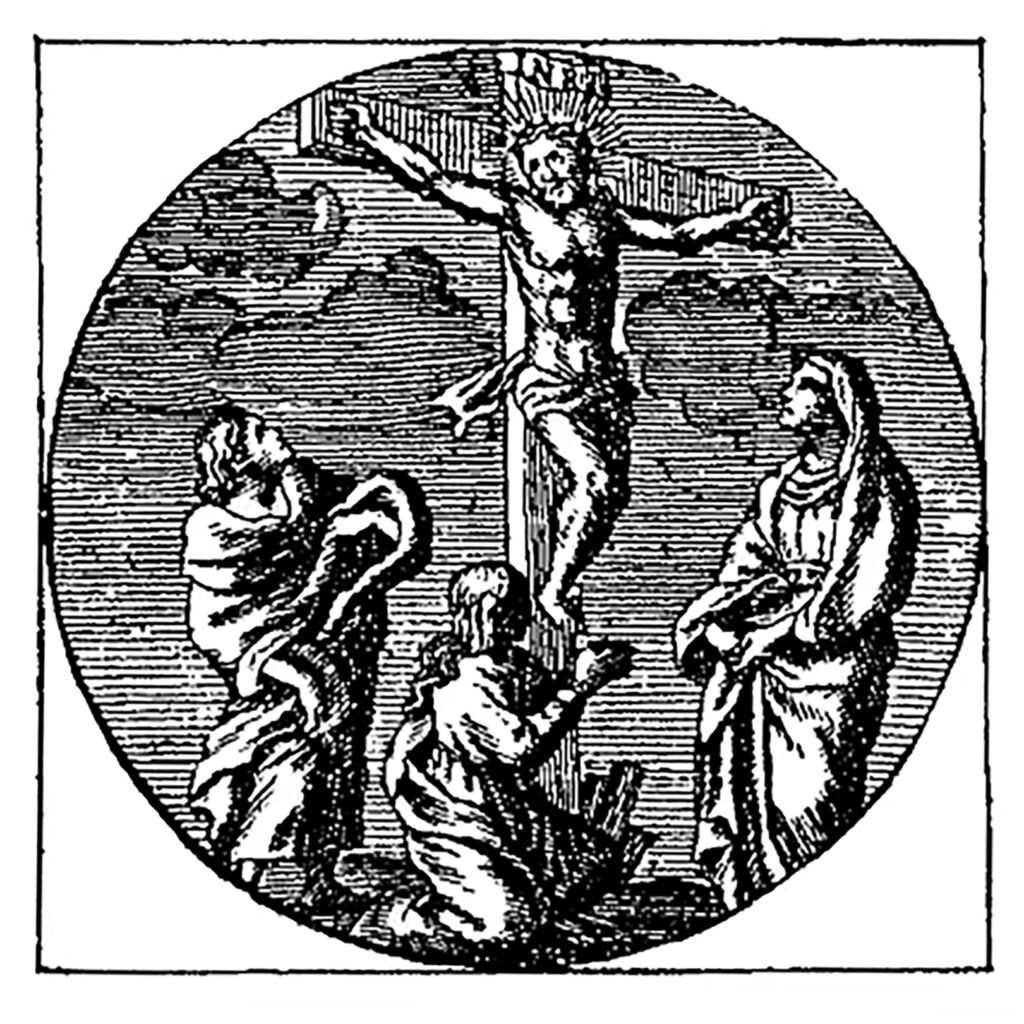
Luke 23:26-56 — The Crucifixion of Jesus
33 When they came to the place called the Skull, they crucified him there, along with the criminals—one on his right, the other on his left. 34 Jesus said, “Father, forgive them, for they do not know what they are doing.”[b] And they divided up his clothes by casting lots. 44 It was now about noon, and darkness came over the whole land until three in the afternoon, 45 for the sun stopped shining. And the curtain of the temple was torn in two. 46 Jesus called out with a loud voice, “Father, into your hands I commit my spirit.”[d] When he had said this, he breathed his last.
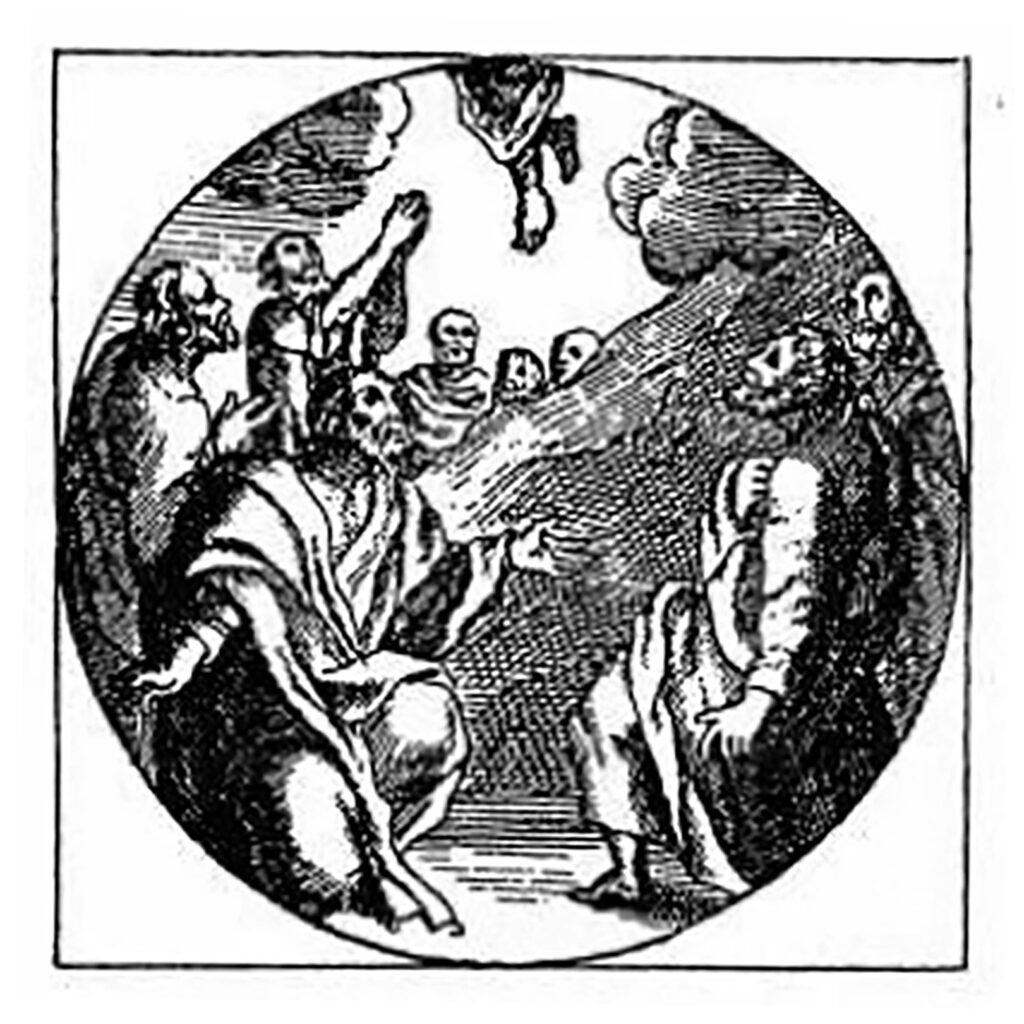
Luke 24:50-53 — The Ascension of Jesus
50 When he had led them [the 12 apostles] out to the vicinity of Bethany, he lifted up his hands and blessed them. 51 While he was blessing them, he left them and was taken up into heaven. 52 Then they worshiped him and returned to Jerusalem with great joy. 53 And they stayed continually at the temple, praising God.
Olivier Messiaen was born in Avignon, France on December 10, 1908. He was one of the most influential musicians of his generation—a composer, organist, and renowned teacher. As a musician he was deeply rooted in French organ traditions but equally attuned to the new sonorities and styles of Stravinsky, Bartok and Debussy.
At the beginning of his career, he devised a system for using modal harmonies that was completely unique to him. Even as his compositional style evolved in the post-war years, he continued to favor these tonal structures.
The Quartet for the End of Time is widely considered to me one of Messiaen’s most significant compositions. He wrote the work while captive in a German prisoner of war camp during World War II. He was interred with three other gifted and successful musicians: cellist Etienne Pasquier, violinist Jean Le Boulairea and clarinetist Henri Akoka. Messiaen wrote this music to be performed in the internment camp for these players and these instruments and with himself playing the piano . His circumstance dictated that the instrumentation of the quartet be clarinet, violin, cello, and piano. The first performance was given in one of the barracks, which had been adapted into a theater of sorts for an audience of around 400 prisoners.
The link between the apocalyptic nature of the source text from the Book of Revelation and the horror of the raging war seems completely obvious to those of us approaching this music now. However, Messiaen claimed that his circumstances and the subject matter of the piece were not directly related. Throughout the piece he employs devices that are characteristic of his unique style, including the use of plainchant, bird songs, odd rhythmic patterns, and the modal harmonic sonorities he favored.
Messiaen included the citation for the source text that inspired his piece and his own detailed notes for each movement in the published score. These appear below.
Revelation 10:1–2, 5–7 And I saw another mighty angel come down from heaven, clothed with a cloud: and a rainbow was upon his head, and his face was as it were the sun, and his feet as pillars of fire…and he set his right foot upon the sea, and his left foot on the earth…. And the angel which I saw stand upon the sea and upon the earth lifted up his hand to heaven, and sware by him that liveth for ever and ever…that there should be time no longer: But in the days of the voice of the seventh angel, when he shall begin to sound, the mystery of God should be finished….
Crystal liturgy
Between three and four in the morning, the awakening of birds: a solo blackbird or nightingale improvises, surrounded by a shimmer of sound, by a halo of trills lost very high in the trees. Transpose this onto a religious plane and you have the harmonious silence of Heaven.
Vocalise, for the Angel who announces the end of Time
The first and third parts (very short) evoke the power of this mighty angel, a rainbow upon his head and clothed with a cloud, who sets one foot on the sea and one foot on the earth. In the middle section are the impalpable harmonies of heaven. In the piano, sweet cascades of blue-orange chords, enclosing in their distant chimes the almost plainchant song of the violin and cello.
Abyss of birds
The abyss is Time with its sadness, its weariness. The birds are the opposite to Time; they are our desire for light, for stars, for rainbows and for jubilant songs.
Interlude
Scherzo, of a more individual character than the other movements, but linked to them nevertheless by certain melodic recollections.
Praise to the eternity of Jesus
Jesus is considered here as one with the Word. A broad phrase, “infinitely slow,” on the cello, magnifies with love and reverence the eternity of the Word, powerful and gentle, “whose time never runs out.” The melody stretches majestically into a kind of gentle, regal distance. “In the beginning was the Word, and the Word was with God, and the Word was God.” (John 1:1 [King James version])
Dance of fury, for the seven trumpets
Rhythmically, the most characteristic piece of the series. The four instruments in unison imitate gongs and trumpets (the first six trumpets of the Apocalypse followed by various disasters, the trumpet of the seventh angel announcing consummation of the mystery of God). Use of added values, of augmented or diminished rhythms, of non-retrogradable rhythms. Music of stone, formidable granite sound; irresistible movement of steel, huge blocks of purple rage, icy drunkenness. Listen especially to all the terrifying fortissimo of the augmentation of the theme and changes of register of its different notes, toward the end of the piece.
Tangle of rainbows, for the Angel who announces the end of Time
Recurring here are certain passages from the second movement. The angel appears in full force, especially the rainbow that covers him (the rainbow, symbol of peace, wisdom, and all luminescent and sonorous vibration). In my dreams, I hear and see ordered chords and melodies, known colors and shapes; then, after this transitional stage, I pass through the unreal and suffer, with ecstasy, a vortex, a dizzying co-penetration of superhuman sounds and colors. These swords of fire, this blue-orange lava, these sudden stars: there is the tangle, there are the rainbows!
Praise to the immortality of Jesus
Large violin solo, counterpart to the violoncello solo of the fifth movement. Why this second eulogy? It is especially aimed at the second aspect of Jesus, Jesus the Man, the Word made flesh, immortally risen for our communication of his life. It is all love. Its slow ascent to the acutely extreme is the ascent of man to his god, the child of God to his Father, the being made divine toward Paradise.