
This concert features music of Johann Sebastian Bach, a new piece rooted in his legacy, and a Romantic era masterpiece by a great admirer. Bach continues to hold a profound influence over new generations of composers. The emotional power and structural clarity of Bach’s music have made studying and performing it an essential journey for all serious musicians.
J. S. Bach had absolute mastery over practices of the past. His music is a magical synthesis of all that came before, his own innovations, and music that was to come. Critic Alex Ross of the New York Times has written, “Bach became an absolute master of his art by never ceasing to be a student of it. [His works] are rooted in archaic chants, hymns, and chorales. They honor, with consummate skill, the scholastic discipline of canon and fugue[and] make expert use of the word-painting techniques of the Renaissance madrigal and Baroque opera. They allude to courtly French dances, Italian love songs, [and] the polonaise. Their furious development of brief motifs anticipates Beethoven, who worshipped Bach when he was young. And their most daring harmonic adventures—for example, the otherworldly modulations in the ‘Confiteor’ of the B-Minor Mass—look ahead to Wagner, even to Schoenberg”.
Bach came from a musical family, and his progeny continued the family legacy. So pronounced was the clan’s gift, they became the subject of genealogical studies charting genius.
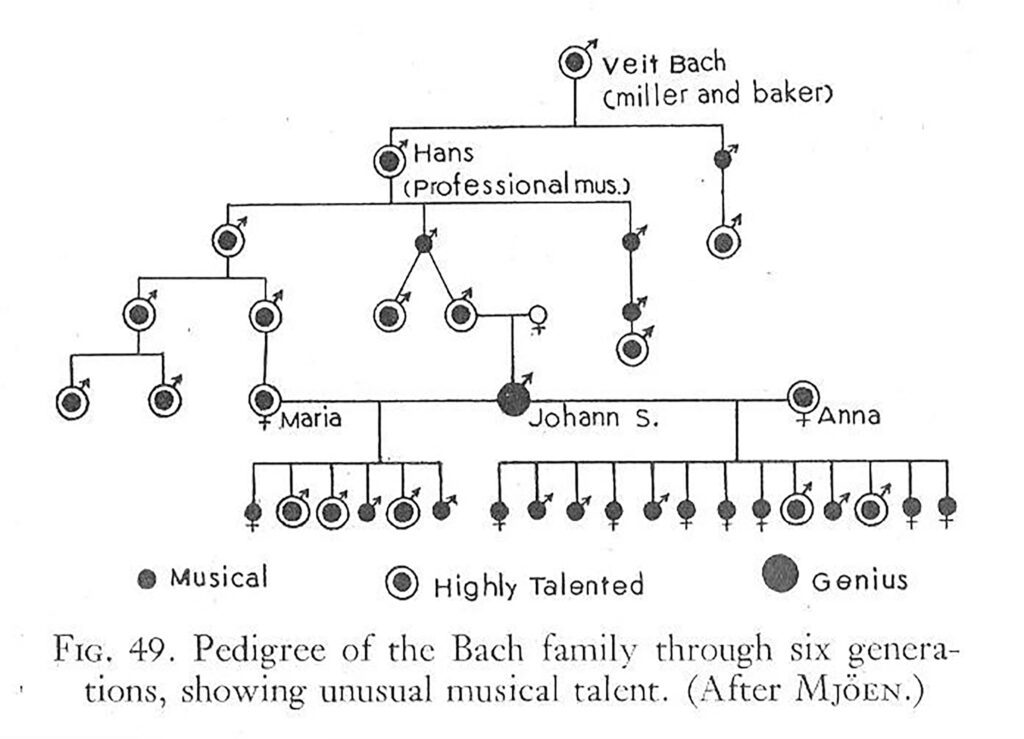
“Inheritance” of musical talent in the pedigree of the Johann Sebastian Bach (from EC Colin.1942. Elements of Genetics, 2nd ed.)
Bach worked as an organist before accepting a secular position as the head of all musical activity in the court of Prince Leopold of Anhalt-Köthen in 1717. His job was to entertain, and he had a small orchestra of wonderful musicians at his disposal. Not surprisingly, these are the years that he produced some of his most enduring instrumental pieces, including the Brandenburg Concertos, the Sonatas and Partitas for solo violin, the first book of the Well-Tempered Clavier, and the six Cello Suites.
The story of the cello suites is odd. In a nutshell: they were completed around 1723, disappeared until published in 1825, and were rediscovered in 1890 by 13-year-old Pablo Casals, who happened upon a copy of the music in a thrift shop in Barcelona. Casals worked on the suites privately for years before eventually introducing them into his concert repertoire. From 1936-38 he recorded all six suites, finally bringing the music into the limelight after 200 years.
Published editions run the gamut from spurious (an edition from the 19th century “fixing” Bach’s errors to make them properly suit the cello); to scientific (a 1929 publication with blown-apart notation seeking to show the player how to inflect and group notes); to DIY (an edition created in 1970 with just the pitches and no other interpretive markings). So why did it take us so long to appreciate these masterpieces? The simplest observation is that Bach required cellists to do things with which they were not comfortable—yet. There are string crossings, wide melodic leaps, and slurred groupings of pitches that were not ‘normal’ for an 18th century player still struggling to comfortably hold the still-developing instrument. In 1720 the cello shape and dimensions we know today were newly established, and the innovation of the endpin was still 100 years out.
So, did Bach write unplayable music? No. We should remember that Bach played the viola, which shares the tuning of the cello, only one octave higher. Bach could have played or imagined physically playing every single note of these pieces on the viola. Every note is possible and perfect.
Tonight we present the 5th cello Suite played on the viola. In his composition, Bach required the top string to be tuned down from A to G, giving the instrument wonderful open resonance. Although cellists do opt to play the piece with a normal tuning, Kenji Bunch will be performing it as Bach meant it to be.
David Conte is the composer of more than one hundred and fifty works published by E. C. Schirmer Music Company, including six operas, a musical, works for chorus, solo voice, orchestra, chamber music, organ, piano, guitar, and harp. He is Professor of Composition and Chair of the Composition Department at the San Francisco Conservatory of Music. From 2011 to 2022 he served on the composition faculty of the European American Musical Alliance in Paris, and in 2011 he joined the board of the American Composers Forum. He has provided the following note about his piece:
Partita for Solo Marimba and Piano is an arrangement of my Partita for Two Marimbas, which was commissioned by the ISGM New Music Commissioning Fund for Marimbist Makoto Nakura, and was premiered by him and Kazuko Ogawa on October 13th, 2021 at Tokyo Bunka Kaikan Recital Hall. Because this recital featured music by J. S. Bach, in that spirit my Partita features some of the most salient characteristics of the style and form of Bach’s music, including motor rhythm, Baroque dance suite forms, and various contrapuntal procedures. The present arrangement for Solo Marimba and Piano was undertaken in 2022.
The Partita begins with a Prelude in E major marked Allegro which features an animated, “perpetual motion” rhythm in the Marimba, accompanied by supporting harmonies in the piano. The character is exuberant and cheerful. The second movement is a Canon modeled somewhat on Robert Schumann’s pieces for the pedal piano. It is in the contrasting tonality of G minor and in a moderate 4/4 meter. The two parts are in strict canon at the octave. The third movement is a Choral Prelude in the sunny key of C major. The piano plays a flowing, cantilena melody accompanied by a steady “walking bass.” A tune in the Marimba in longer tremolo notes resembling a chorale melody weaves in and out. The suite concludes with a Gigue in the opening tonality of E major. Marked Allegro giocoso, this movement features three successive contrasting themes—the first, jovial; the second, more humorous; the third, lyrical—which are developed and restated. The work ends with a fast and brilliant coda.
The Partita was composed in close consultation with Makoto Nakura. He gave invaluable suggestions and advice at all stages of my work to make the work as idiomatic as possible. I am very grateful for his generous collaboration.
Johannes Brahms’ father, Johann Jakob, had pursued music as a career in defiance of his family and had ended up in Hamburg finding work as a street musician. Eventually he became a bass player in the Hamburg City Orchestra. He is assumed to have given Johannes, his second child, his first lessons in music. By age seven Johannes was studying piano with Otto Cossel, a highly regarded teacher. He progressed very quickly. When Brahms showed interest and talent in composition, Cossel arranged for him to have lessons in counterpoint. With money tight at home, Brahms was able to help bring in income by composing and arranging music for his father’s small party orchestra and by recommending his father as a musician. In 1848, Hungarian insurgents arrived in Hamburg to escape Russian oppression. They brought with them a style of music that became a craze in Germany. Brahms had his first exposure to the gypsy czardas and the alla zingarese styles that were to influence him throughout his artistic life. This was also when he first met the Hungarian violinist Eduard Remenyi, who schooled him in the style and taught him how to exploit rubato in ensemble playing.
In 1853, twenty-year-old Johannes Brahms teamed with Remenyi and began a concert tour of northern Germany as his accompanist. After performing in Hanover, the two arrived in Göttingen where Brahms met the great violin virtuoso Joseph Joachim, who would remain a lifelong friend and colleague. The tour continued to Weimar, where Brahms met Franz Liszt. There he and Remenyi parted ways. After taking a brief hiking vacation in the Rhineland and armed with a letter of introduction from Joachim, Brahms travelled on to Düsseldorf where he first met Robert and Clara Schumann.
The Piano Quartet opus 25 was written in 1861 and given its premier in November of that year with Clara Schumann at the piano. In 1862 Brahms made his first trip to Vienna where, carrying an introduction from Clara and some other friends, he was able to mount solo recitals that garnered very favorable attention. Among the works he presented was this quartet.
The piece is dedicated to Baron Reinhard von Dalwigk. It is an epic forty-five minutes long, a major innovation at the time. It is also the first time Brahms used the gypsy style in one of his compositions. The first movement has an extended exposition with three distinct themes. The music is overall dark and brooding. The placement of a Scherzo or Minuet movement second in a four-movement chamber music work was also new. Normally a slow movement would go here. The choice to label it Intermezzo reflects the more subdued nature of the music. The third movement Andante con moto is again intensely lyrical with a middle section that is actually a march but in three-quarter time—very unusual. The Finale is pure gypsy, full of wild energy and gushy rubato. The end of the movement couldn’t be more exciting.