The music in this concert is all connected to place. Wolfgang Amadeus Mozart’s Trio in E-flat major, K.498 (1786), which begins the concert, bears the subtitle “Kegelstatt”. This translates roughly as “the place where skittles are played”. Adolphus Hailstork’s Piano Quintet “Detroit” (2018) celebrates the city that nurtured him in his art. The final work on the program is Antonín Dvořák String Quintet No. 3 in E flat major, Op. 97 “American” (1893), a piece born directly from the composer’s summer stay in Spillville, Iowa.
So why exactly would a perfectly lovely piece—Mozart’s Trio in E-flat major, K.498 for clarinet, viola, and piano—be named after a pool hall? The answer is no one is quite sure.
There is in fact another work that Mozart wrote while actually playing skittles, namely the12 Duos for 2 Horns, K. 487, which were composed waiting between turns while hanging out with the French horn virtuoso Ignaz Leutgeb. Mozart inscribed the score with the words: Vienna, 27 July 1786 while playing skittles.
The Trio K.498 was written a mere week and a half later, but far from that environment. It was composed for his favorite piano student, Franziska von Jacquin. Mozart was close friends with her father and brother and took part in house concerts given in the family home. Since Mozart was a virtuoso pianist, you would think he’d have played the piano part, but he was, instead. the violist. Franziska von Jacquin played the piano and Anton Stadler the clarinet.
Mozart loved the clarinet and the way Stadler played it. He wrote gorgeous works for the still-developing instrument because of this association. Beyond this professional admiration, Mozart had an abiding affection for Stadler, who had a reputation for being a bit untrustworthy. Stadler cheated the gentleman who was working with him on improving the clarinet’s design by never actually paying him for instruments. He went further by claiming credit for building them after the poor man’s death. He borrowed money from Mozart that was never going to be repaid. Mozart’s nickname for him was ‘Notschibinitschibi’ combining the words ‘Notschibi’ and ‘Nitschibi’ which mean ‘poor booby or miser’ and ‘a young man of follies’.
The nickname Kegelstatt first appeared attached to the trio in 1862 in Ludwig von Köchel’s thematic catalogue of Mozart’s music. No one knows why. Maybe it was enough that Stadler was the type of guy Mozart would have bowled with.
The piece is all elegance. The first movement starts with a mini-introduction of melodic long notes, flourishes and silence that leads to the first major theme. Those flourishes appear throughout the movement, driving each change in mood and character. The second movement, Minuet and Trio, alternates boot-stomping simplicity with elegant counterpoint. The trio section contrasts a four-note rippling gesture and driving quick triplets. There are moments when this three-part music suddenly becomes four parts as Mozart weaves the counterpoint through clarinet, right-hand piano, viola, and left-hand piano. The finale is a rondo. Mozart writes wonderfully, contrasting interludes between each return of the rondo theme.
Dr. Adolphus Hailstork was born in 1941 in Rochester, NY, and raised in Albany. His main musical education came from the tradition of the Anglican Episcopal church where he sang as a boy soprano and served as an altar boy. He also learned the piano and organ. He went on to study composition at Howard University with Mark Fax, the American Institute at Fontainebleau with Nadia Boulanger, and the Manhattan School of Music with Vittorio Giannini and David Diamond. After completing a tour of duty in the Army, he entered Michigan State University in 1968 and earned a Doctorate in Composition as a student of H. Owen Reed. He has enjoyed a 60+ year career, and his catalog includes works for chorus, solo voice, piano, organ, various chamber ensembles, band, orchestra, and opera.
Dr. Hailstork currently lives in Virginia Beach, Virginia, and is Professor of Music and Eminent Scholar at Old Dominion University in Norfolk.
The city of Detroit has served a major role in Hailstork’s early professional growth. Over the years he has received commissions from and collaborated with many important performers and institutions based there. His piano quintet ‘Detroit’ depicts the city that nurtured him. The music is rooted in both classical musical and African-American traditions. Elements of folk, blues, jazz, and gospel are all in there.
The first movement, Detroit Grit, is dark and dramatic, with quartet flourishes and pounding piano chords that convey determination, resilience, and the will to survive.
The second movement, Detroit Nocturne, depicts the city at its lowest. In the classical tradition a nocturne is a piece of music inspired by or meant to evoke the night. Hailstork’s nocturne begins with a dejected stillness. A pulsing blues infuses the music with a sense of hope. A return to stark stillness like that of the opening closes the piece, but the hope lingers.
The third movement Detroit Rise begins in the quiet place carried over from the previous movement. This music evokes the economic collapse and social decline that devastated and exhausted the city at the beginning of this century. And then it abruptly shifts into triumphant driving jazz dance music full of purpose and fire.
The final movement, Prayer, is a gentle gospel hymn dedicated to the memory of Brazeal Dennard, who was a mentor to Hailstork and directed the Brazeal Dennard Chorale based in the city. This music is patient, imparting a sense of gratitude and a deep trust that change will come.
Antonín Dvořák was born in the village of Nelahozeves, in what is now the Czech Republic, in 1841. His father was an innkeeper and butcher. His early study of music included learning the violin, viola, piano, organ, and keyboard harmony. In 1857 he entered the Prague Conservatory as an organist. His first regular employment after graduation was as principal violist in the Provisional Theater orchestra. He performed under the baton of both Smetana and Wagner in these years.
Dvořák’s had his first major success as a composer in 1873. By the 1880’s, he was travelling widely to conduct and present his own music.
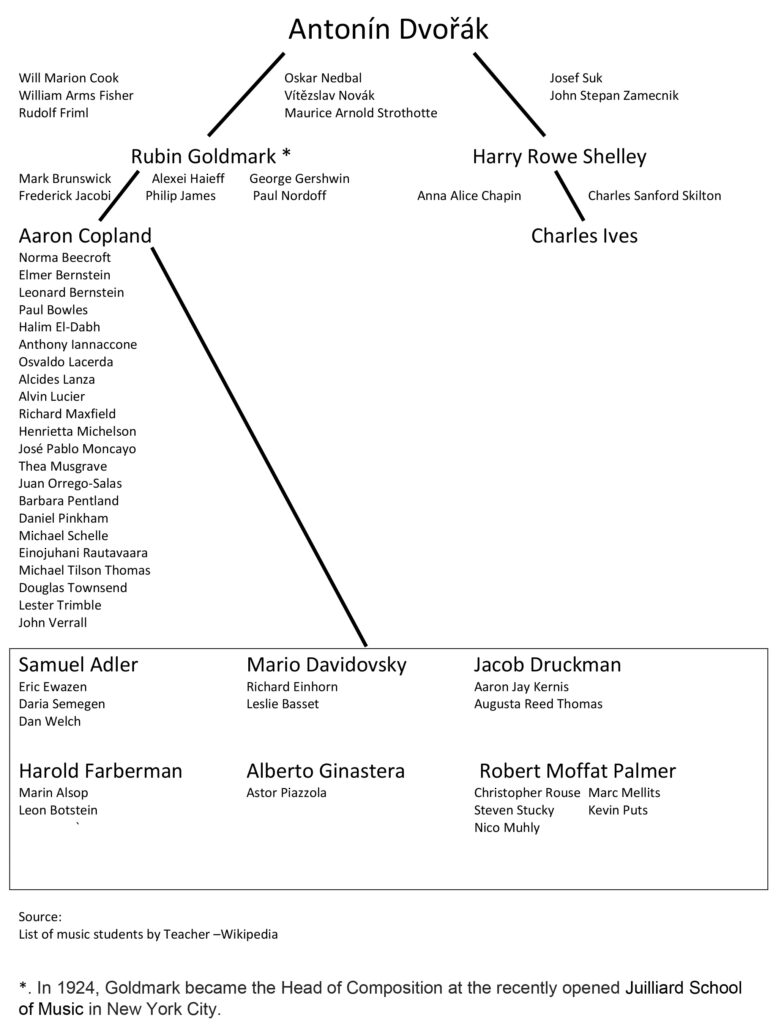
In 1892, Dvořák came to the United States to become the director of the National Conservatory in New York City. He had been courted for this position as a figurehead, not an administrator, and was expected to use his great gift for capturing in sound the ethos of place and thus to establish a new school of American composition. The chart that follows this note shows the impact his brief stay here had on generations of American composers.
Much has been written about Dvořák’s compositions that stemmed from his stay in America—in both New York City from 1892 to 1895 and in Spillville, Iowa during the summer of 1893. In short, he identified the unique sound of ‘here’ and used those elements to create original music very different from anything he had done before. He shared this realization in a letter to a friend, stating, “I know that if I had not seen America I never should have written my new symphony [“From the New World” opus 95] or my string quartet [“American”, opus 96] or my quintet [“American” opus 97] the way I did.”
When reacting to the statement that he had co-opted existing material in his writing, Dvořák wrote in another letter a few years later, “Omit that nonsense about my having made use of ‘Indian’ and ‘American’ themes—that is a lie. I tried to write only in the spirit of these national American melodies.”
Dvorák’s stated goal in his quintet was “to write something really melodious and simple”. He certainly achieved this. The use of a second viola brings added warmth to the ensemble. There are identifiable traits of Native American and African American music throughout, as well as the open resonating chordal harmonies Dvořák utilized when writing music from this New World.